Christmas Traditions for Families: Baubles, Keepsakes & Little Rituals
18 thoughtful ways to make Christmas feel like yours, from a bauble that remembers the year to simple family rituals, meaningful gifts and memories to keep.
In this guide

Some of the best Christmas traditions begin almost by accident.
A song goes on while the decorations come out. Someone insists on hanging the slightly lopsided paper star. A child asks why there is a key on the tree, and the story of the old house gets told again. Next December, everybody remembers and wants to do it once more.
Family Christmas traditions do not need a packed calendar or a perfectly coordinated tree. They need something small enough to repeat and personal enough to feel like yours. That might be a decoration marking a new chapter, an annual photograph, a familiar walk or a handwritten note tucked away with the baubles.
This guide brings together 18 ideas for decorating, spending time together, giving thoughtfully and keeping the memories. Choose the ones that fit your family now, with room for them to change as children grow and life moves on.
Start with a tradition you can happily repeat.
Before making a list, think about the December you actually have. Work, school events, travel, tired evenings and other commitments all take up space. A tradition that needs three hours of preparation may be lovely once; a short activity with a familiar beginning can be much easier to return to.
Choose a dependable cue rather than an ambitious date. You might read the same book when the tree goes up, take a picture before the first festive film or write a note while packing decorations away. Linking the ritual to something already happening saves it from becoming another task to remember.
Let everyone have some say. One person may love decorating while another would rather choose the music or make the sandwiches. Children can suggest the film, draw an invitation for the decorating afternoon or decide where their own ornament belongs. Participation can look different for each person.
A family tradition also needs permission to evolve. A toddler's ten-minute story time may become a longer board-game evening. A walk can become a drive when that works better for someone. Missing a year does not erase the years before it.
The familiar part
The same story, song, decoration or shared place.
The practical part
The time, date, length or way people join in.
The pressure
Anything that turns a welcome ritual into an obligation.
Build a Christmas tree that remembers your family.
A tree can hold a record of ordinary years and extraordinary ones. The most interesting collection may include something bought, something made, something inherited and something nobody else would understand without hearing the story.
Choose one bauble to remember the year.
Instead of choosing a new theme for the whole tree, choose one decoration connected to the past twelve months. It could represent a new home, a much-loved pet, a wedding, a baby or a hobby that became a surprisingly important part of family life.
Give the choice a sentence: “This is the year we moved”, “This is when you learned to swim” or “This reminds us of that holiday”. Write the explanation on a small card and store it with the decoration. The meaning will be much easier to recover years later.
Our Christmas baubles include personalised designs for several family milestones. A handmade paper decoration can serve the same purpose; what makes the tradition personal is the story you attach to it.
Tell the stories as the decorations come out.
Open the decoration box before worrying about where everything will go. Let each person choose one familiar ornament and explain what they remember about it. A grandparent might know where an older piece came from; a child may remember who helped make a decoration at school.
If nobody knows an ornament's history, record that honestly rather than inventing one. “We have had this for as long as I can remember” is a lovely beginning. You can start a new chapter by noting who hangs it this year.
A short voice recording, made with the person's agreement, is another way to keep the story. Label it clearly and keep a backup somewhere you can find again. The sound of someone explaining a tiny family detail can become part of the keepsake.
Give children a decoration of their own.
Let each child have one ornament they choose, make or help personalise. It gives them a recognisable part in the decorating, especially when adults are deciding where most things go. Their choice may reflect a favourite colour, an animal or a very temporary obsession.
Keep the process manageable. Offer a few options, or put out paper and drawing materials already at home. Add the child's name and year on a separate label if the decoration itself has no room.
As the years pass, their small collection becomes a record of changing interests. There is no need to make every year's choice match. Plan the display so fragile pieces and small detachable decorations are kept appropriately out of young children's reach.
Mark a first Christmas without making the whole season about it.
One ornament can quietly acknowledge a major change. Choose the detail that matters, hang it together and let it become part of the wider celebration. A first Christmas in a new place can be worth remembering whether the rest of the room is beautifully finished or still contains moving boxes.
These four examples show different ways to record a chapter. They are options for a tradition, rather than a checklist of things a family needs to buy.

A first Christmas at home.
A key-shaped new home bauble can record names, a family name or a street address, with a chosen year. Pick the personalisation style that tells your story, then check the exact wording. A postcode or full postal address is not needed for the street-address version.

A growing family tree.
A family bauble can bring chosen family characters, names and a year into one decoration. This design offers adults, children, babies, cats and dogs, with up to twelve characters. Check the character count and left-to-right order as well as the names.

A little one's first year.
A first Christmas bauble can keep the baby's name and chosen year together. The raised-name design shown here has a painted wooden first name on natural birch. The name colour and pink or blue ribbon are separate choices, so check both before ordering.

A shared name and a date to remember.
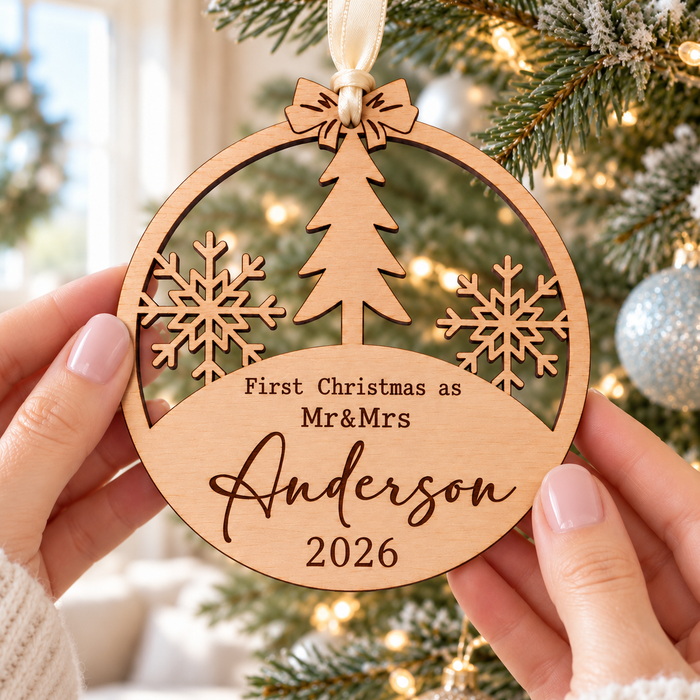
Some couples enjoy adding wedding ornaments to their tree. The featured wooden design uses the standard “First Christmas as Mr & Mrs” wording with a surname and year. For different titles or two first names, ask about the layout before ordering rather than assuming the standard wording will change.
Take the same tree photograph each year.
Choose a simple place to stand or sit and take one photograph when the decorating is finished. The interesting part will be the small changes: a child's height, a different room, a familiar jumper or the pet that never looks towards the camera.
Include the people who would like to be in it, including the person usually holding the phone. A timer can help, but an imperfect photograph is still a record. Take a picture of the tree alone as well, especially if individual decorations are important to you.
Save the images in a clearly named album and print a favourite if you want something for the decoration box. Avoid turning the photograph into a long session that delays the enjoyable part of the evening.
Make space for the familiar things.
The weeks before Christmas can hold their own rituals. Keep them flexible enough for a weekday evening, a quieter weekend or whichever days your family spends together.
Make a neighbourhood lights walk your annual outing.
Choose a familiar route, wrap up for the weather and look for the displays people have put up. It can be a short walk around nearby streets rather than a ticketed event. Let children notice the smallest details: a window star, a door wreath or a garden full of snowmen.
If walking does not suit everyone, adapt it to a short drive or a view from a favourite window. Decide where you will finish and make that the cosy part, perhaps a drink and a snack back at home.
Keep a note of one thing everybody liked. Returning to the same streets next year gives the outing a recognisable shape without requiring the displays to be identical.
Return to a Christmas story.
Set aside one book that comes out with the decorations. Read it on the first evening the tree is lit, before Christmas Eve bedtime or during a quiet afternoon. A library book can work just as well if you can borrow it again.
For younger children, a short story is enough. Older children may enjoy taking turns reading, choosing a new book to sit beside the familiar one or remembering the parts they once knew by heart.
A family member elsewhere could read over a call, if everybody would enjoy that. Keep the timing kind to the person listening; the tradition is sharing a story, not finishing a certain number of pages.
Build a playlist one song at a time.
Ask each person to add a song, then use the playlist while decorating, cooking or travelling. Let the choices reflect the people involved, including the track that makes somebody laugh rather than only the music an adult thinks belongs at Christmas.
Write down the year's additions in a notebook or on the back of the annual photograph. A named list survives changes of phone or music service more easily than a link alone.
If background music is tiring for someone, make listening a shorter activity or use the playlist at another time. A shared choice can be part of the tradition even when the house stays quiet.
Make one familiar thing in the kitchen.
Choose something realistic for the time and energy available: decorating ready-made biscuits, mixing a favourite cake or preparing a simple breakfast. Children can help with a suitable task while an adult handles the parts that need it.
Keep the recipe or a photograph of the result with a note about who helped. The family version may gradually acquire its own details, such as an unusual shape, extra sprinkles or the plate everybody expects to see.
Use food that suits the people taking part and the dietary needs you already know about. There is no requirement for a traditional Christmas recipe. Familiarity is what makes the activity repeatable.
Choose one small act of kindness together.
Let the family decide on something manageable. You could write a thank-you card, check in with a neighbour, offer a useful errand or support a local collection after checking what it currently needs.
Give children a genuine part in the choice, with age-appropriate help. Ask who might appreciate a kind word or practical support rather than treating the activity as a performance to photograph.
If donating items or money is part of the plan, agree a limit first. Time, attention and a carefully written message can also be worthwhile contributions. Keep the focus on the person receiving the kindness.
Make giving feel personal.
A small gift can become part of a tradition when it has a clear connection to the person receiving it. Among personalised Christmas gifts, a name or year can record that connection, but the accompanying words often explain why you chose it.
Add a note that explains the choice.
Write two or three sentences about the gift rather than repeating what is on its label. Explain the memory, the family joke or the part of their year that made you think of it. This gives the recipient a story to keep with the object.
A new-home decoration might come with a wish for the celebrations still to happen there. A family keepsake could include a note about the ordinary afternoons you enjoy together. A baby's ornament might explain who chose it and why.
Use your own voice. A plain sentence that sounds like you is usually more personal than an elaborate greeting. Date the note and sign it; those small details become useful when the gift is brought out again.
“For the first Christmas in the place you will fill with your own memories.”
“A little reminder of all of us, and the year we will always talk about.”
Suggested card messages to adapt in your own words.
Make room for one shared family gift.
A shared present can be something to do together: a game, a book for taking turns with, an activity at home or an outing that suits the family budget. Agree what is included, especially if several households are contributing.
If the gift is a keepsake, decide where it will live and who it represents. Check every name with the people concerned. Personalisation is most useful when the details feel right to the family receiving it, rather than when a surprise forces you to guess.
You could make opening the shared gift a familiar moment each year, followed by using it together. Keep the ritual loose enough to work if someone is away, a young child is tired or the usual day needs to change.
Share a small ritual across the distance.
Families living apart can choose one thing to do in parallel. Put up a particular decoration, read the same story, exchange a photograph of the tree or open a handwritten card during a short call.
Choose a time that works for the different households, with a simple alternative if the call does not happen. A voice message or photograph sent later can still keep the connection. The point is the shared reference, rather than everybody performing the same activity at exactly the same moment.
If a relative gives a decoration, send a picture of it in its new place with their permission before sharing more widely. It can be a lovely way to show that their gift has joined the family's Christmas collection.
Let traditions travel between homes.
Children and adults may spend Christmas across more than one household. A familiar book, song or short activity can provide a small connection between celebrations without making each home's Christmas identical.
Agree practical details with the other people involved. A portable keepsake should be easy to keep track of, and a favourite decoration might stay safely in one place while a photograph or drawing travels instead.
Use language that leaves room for both homes and for plans to change. Traditions can happen before or after Christmas Day. Being able to repeat something together matters more than making the date do all the work.
A first Christmas can be small and still matter.
With a new baby
A first festive season does not need a full programme. A photograph, a short note about the baby's first year and one chosen decoration can be enough. Fit the celebration around the baby and the people caring for them, with room to leave plans unfinished.
Choose one thing you would like to find in the decoration box next year. It might be a printed picture, the card from a grandparent or a named keepsake. You can add more memories later; they do not all need to be made on Christmas Day.
In a changed family year
A move, separation, illness or somebody's absence may change the usual shape of Christmas. Ask which parts people want to keep and which they would prefer to adapt. There is no need to repeat an activity simply because it has always happened.
Some families like to include a favourite song, recipe or quiet moment connected to someone they miss. Others prefer a different plan for now. Let people choose how much they want to join in, and allow that choice to change.
Keep the little details you might otherwise forget.
You do not have to preserve everything. A few dated notes and selected photographs can give the keepsakes their context, so the box still tells a clear story when you open it years later.
Write a short letter to next year's family.
Describe the Christmas you are having in ordinary detail. Where are you living? Which song has been requested repeatedly? What has made everybody laugh? Include a small hope for the coming year, without turning the letter into a set of targets.
Keep it brief enough to finish. Each person can contribute a sentence, a drawing or a dictated thought. Put the date on it and decide whether to read it when the decorations come out next year or keep several letters together for later.
If you write about another person, be considerate about what you record and who will read it. The letter should feel like something the family will be comfortable discovering together.
Create a small Christmas memory box.
Choose a clean, dry box or folder and give it a clear purpose. You could keep one annual photograph, a few handwritten cards, the year's letter and a child's favourite piece of festive artwork. A separate folder can stop paper items disappearing among ribbons and hooks.
Label the year and add a sentence explaining unfamiliar objects. If the collection grows, keep a short contents list so you do not have to unpack everything to find a particular note.
Store keepsakes away from damp and direct sunlight, and let anything made from food or natural materials remain a temporary decoration rather than putting it into a long-term paper collection. A photograph can record something that will not store well.
Ask children the same few questions.
A tiny annual interview can be more revealing than a long journal. Ask about a favourite story, something they learned, a person they enjoyed spending time with and one wish for the next year. Write down their words as they say them.
For a younger child, a drawing or a single answer is enough. Older children might prefer to fill out their own page or leave some questions blank. Make joining in optional and avoid turning the answers into a test of how festive they feel.
Date each page and keep the questions broadly similar. Over time, the changing handwriting, interests and way they describe the world become part of the tradition.
Four little things to write down.
This year I loved…A person, a place or something we did.
Something that made me laugh…The detail you will want to remember.
My favourite Christmas moment…Big, small or completely unexpected.
Next year I hope we…One idea to open again another December.
Pack the story away with the decoration.
Before the decorations go into storage, take a moment to check ribbons, separate delicate pieces and put named keepsakes somewhere they will be easy to find. Follow the care advice for each material; wooden ornaments should be kept dry and protected from heavy objects.
Attach the short story card to the wrapping or storage envelope, rather than relying on everyone remembering what an ornament means. Include the names, year and who gave it if that is part of the story.
Finally, leave next December a welcome: the playlist on paper, the chosen book near the top or the annual letter ready to open. Packing away can be the closing chapter of this Christmas and the beginning of the next one.
A small plan is enough.
Pick three ideas from the guide: one shared activity, one way to include somebody else and one memory to keep. The table below offers starting points rather than a schedule to complete.
| Your family this year | An easy starting point | A memory to keep |
|---|---|---|
| With a baby | A brief tree photograph when the timing suits. | A printed picture and a dated note. |
| With young children | Choose a story or make one paper decoration. | Their drawing or exact words. |
| With older children | Let them choose music, food or the shared activity. | A few lines about their choices. |
| Across homes | Share a photograph, story or short call. | A message or card from each home. |
| On a smaller budget | A familiar walk, library book or handwritten letter. | A story card for a decoration you already own. |
We will do this together: ____________________
We will include someone by: ____________________
We will keep this memory: ____________________
Family Christmas traditions: your questions.
How do you start a Christmas tradition as a family?
Choose one activity you already enjoy, give it a familiar cue and repeat it when it suits your family. Reading a book when the tree goes up or taking an annual photograph are simple starting points. Let family members help choose the parts they want to keep.
What are some inexpensive family Christmas traditions?
Try a neighbourhood lights walk, a library story, a shared playlist, paper decorations or a letter to open next year. You can also write the history of a decoration you already own. A tradition does not need a new purchase each December.
What is the one-bauble-a-year tradition?
It means choosing or making one decoration each year to represent a memory, milestone or person. Add the year and a short explanation on a separate card if needed. Over time, the ornaments form a collection connected to your family's story.
Can Christmas traditions work for a baby's first year?
Yes. Keep them brief and flexible: a photograph, a short letter or a chosen decoration can mark the year. Arrange the timing around the baby and the people caring for them. There is no need to fit every activity into the first festive season.
What should you put on a personalised Christmas bauble?
Use the fields offered by the chosen design. Our featured baubles may ask for a first name, surname, family characters, an address or a year. Standard wording can already be included, so check the listing rather than adding extra text automatically. Ask first about a different layout.
How can relatives join in when they live far away?
Share a short call, a familiar story, tree photographs or handwritten cards. A voice message is a useful alternative when a live call does not work. Agree what everyone would enjoy and keep the plan flexible across time zones and household routines.
Do all the decorations need to match?
No. A family tree can combine favourite colours, inherited pieces, children's creations and decorations marking different years. If you enjoy a coordinated look, choose a few recurring colours while leaving room for the keepsakes that matter to you.
How do you store wooden Christmas keepsakes?
Follow the care instructions for each product. Keep the wooden baubles featured here dry, wrap delicate shapes gently and protect them from heavier decorations. Store their story cards alongside them so the names, year and meaning are easy to find next Christmas.
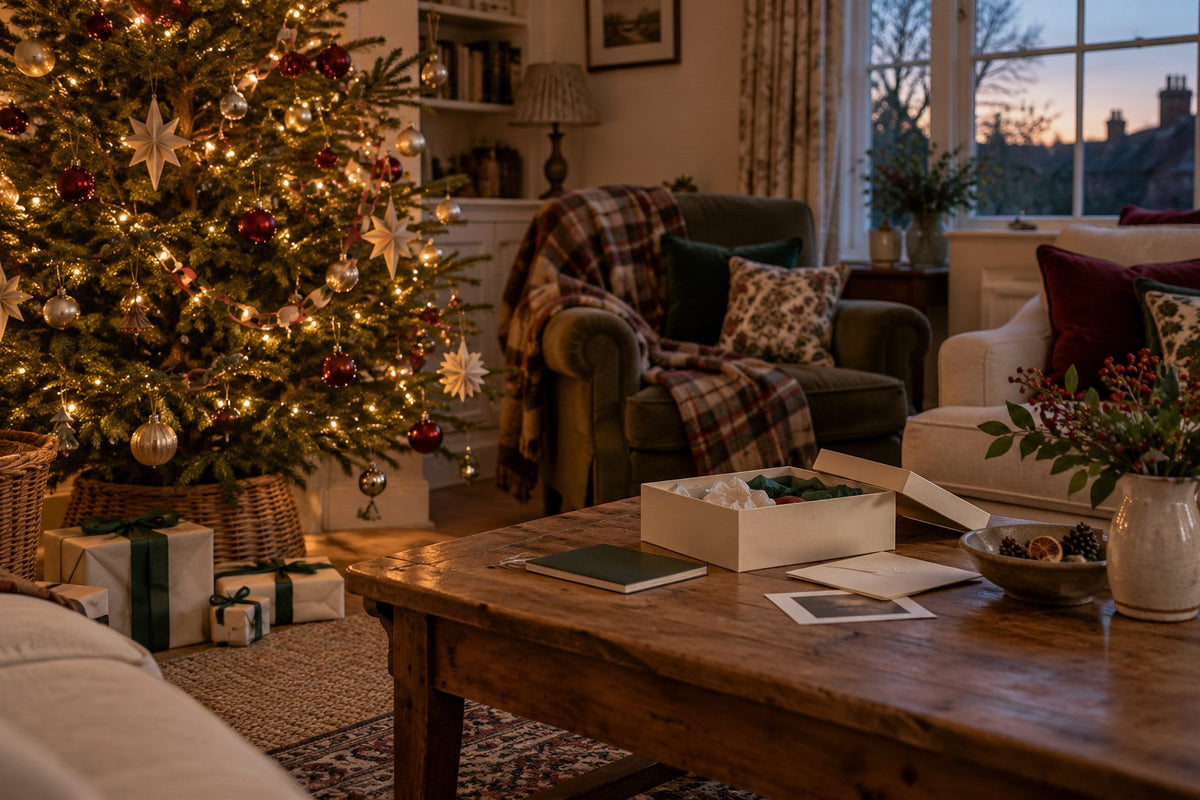
The opening lifestyle image was created with AI for this guide. Product photographs show Creative Mama Gift Shop designs; styling props are not included. The short historical note draws on English Heritage and the V&A, linked above.




Join the conversation +