How to Make a Family Memory Box
What to keep, what to write and how to make a little space for your family's story.
In this guide

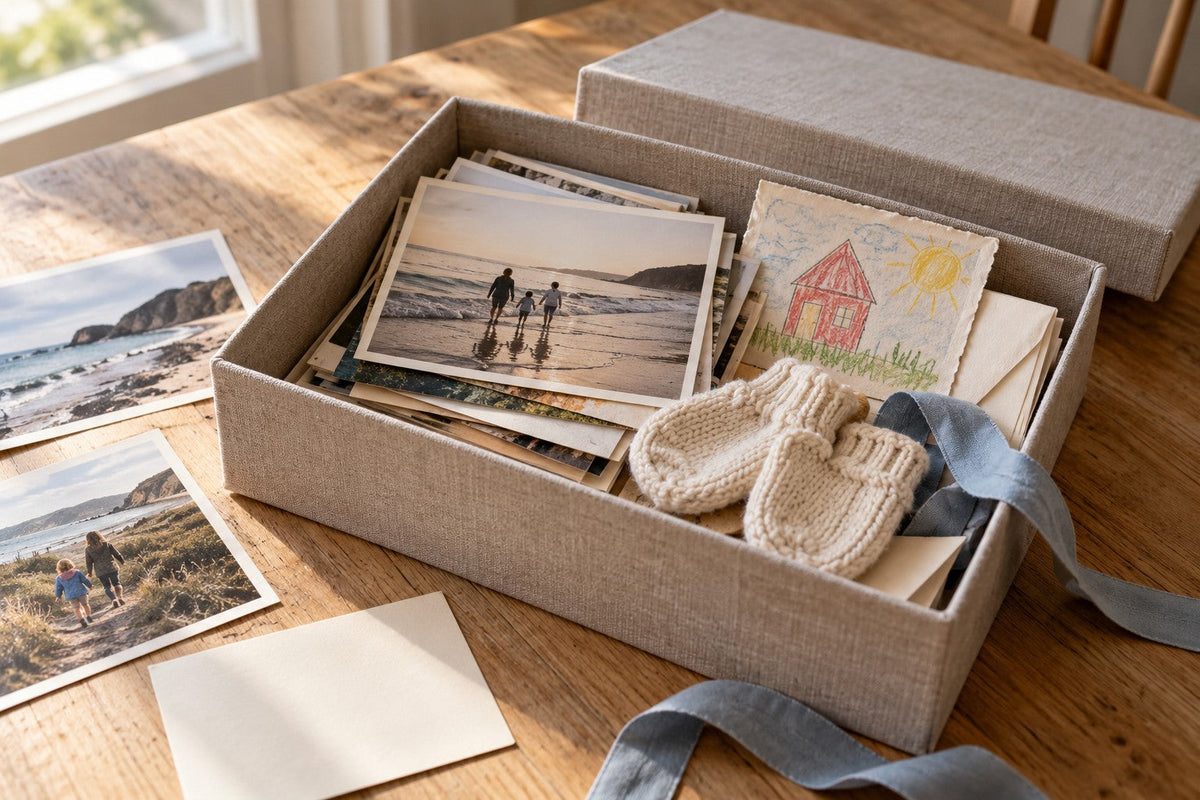
A crumpled drawing. A photograph from an ordinary Sunday. The tiny hat that suddenly looks impossibly small. Some of the things that tell a family's story are the easiest to lose in a drawer.
A family memory box gives those pieces a home. It can hold the beginnings, the everyday moments and the people who made them matter, without turning every cupboard into a collection of things nobody quite knows what to do with.
This guide explains how to make a family memory box, what to put inside, how to organise it and how to keep adding to it as life changes. Start with what you already have; the stories will make it personal.
01 / A simple beginning
Make a family memory box in seven steps
There is no special age, occasion or family set-up you need to begin. A couple can start one before children arrive; grandparents can create a box of shared stories; a child can help build one around the people and places they love.
The most useful approach is small enough to finish. Instead of gathering every photograph in the house, start with one drawer, one year or one milestone.
-
Decide whose story it will tell
Choose between one shared family box, a separate box for each child or a box for a particular chapter, such as your first year together. For a shared box, leave space for everyone's perspective. One person might remember the journey; another might treasure the ticket from the destination.
-
Choose a box that fits your real space
Measure the shelf or cupboard before choosing the container. A shallow box can make papers easier to browse; a deeper one may suit small objects if they have their own inner containers. Leave enough room for the lid to close without pressing on the contents. A beautiful box that is too awkward to lift will rarely be opened.
-
Gather a small first collection
Choose around five to ten pieces as a starting point, rather than a rule. Look for objects with a story you can explain: a note in familiar handwriting, a favourite photograph, a birthday drawing or a keepsake from the year your family changed. You can add more later.
-
Sort before anything goes inside
Make three groups: keep the original, photograph or scan, and let go. A large school project might be represented by a photograph and one small detail. Several near-identical birthday cards might become one favourite card, chosen for its message rather than its cover. Choosing is part of making the collection meaningful.
-
Add a short memory note
Write down who, when, where and why. Use a separate card or the outside of an appropriate storage envelope, rather than writing across the object. An approximate date is fine: “summer before starting school” is more helpful than leaving a future family member to guess completely.
-
Give different materials their own space
Put photographs and papers in suitable sleeves or folders. Keep small objects in their own compartments and cushion delicate decorations so they cannot rub against other items. Avoid making one heavy stack with a fragile piece at the bottom. The box should be comfortable to browse, not a puzzle to unpack.
-
Choose a home and a date to revisit it
Put the box on an accessible indoor shelf or in a cupboard, then choose a simple reminder: a birthday, the end of the school year or a quiet afternoon after Christmas. It becomes a family collection through occasional attention, rather than through saving something every week.
02 / Choose the pieces
What should you put in a family memory box?
Include things that help you remember a person, a moment or the way family life felt. A useful mix is a few photographs, some handwriting and a handful of small objects. Expensive items are not required, and a memory does not have to mark an achievement to deserve a place.
Words in a familiar hand
A birthday message, a recipe card, a little letter from a grandparent or a note left in a lunchbox. Add the writer's full name and their relationship to the family. What seems obvious today may not be obvious to a child reading it in twenty years.
A little of who they were
A drawing, a small item of clothing, a funny phrase or a list of favourite things. Save the date and the child's own explanation of their picture. The three-legged orange creature may have been a very specific dinosaur, even if nobody else could tell.
Days away, big and small
A postcard, an event programme or a photograph of a familiar beach can bring back a whole day. Record the detail that made it yours: the picnic that blew away, the bus everyone nearly missed or the song played all the way home.
The ordinary routines
Keep a photograph of the kitchen table, a handwritten shopping list or a child's description of their usual Saturday. These details show how you lived between birthdays and holidays. A simple note about the dinner everyone requested can be surprisingly revealing later.
One piece from the occasion
Choose an invitation, a meaningful card or a small decoration from a birthday, wedding or family gathering. A short list of who was there can add more than another stack of photographs. Ask someone else what they remember, too.
Stories from before your time
Include a copied family photograph or a page about where an older relative grew up. If an original belongs to someone else, ask before keeping or reproducing it. Write down who shared the story and distinguish their recollection from a confirmed date.
A helpful question
“If someone opened this in twenty years, what would they learn about us?”
The answer matters more than how much space the object takes up.What can you photograph instead?
Oversized art, a much-loved but worn-out toy, a birthday cake and a temporary bedroom display can all be remembered through photographs. Take one picture of the whole thing and another of the detail that matters. Add a few words before moving on; a file called “IMG_4837” will not explain why that cardboard rocket occupied the sitting room for a fortnight.
Keep practical identity documents, certificates and other records in their usual secure place. A memory box can hold a copy or a note about the event without becoming the only location for important paperwork.
03 / The chapters that change a family
Three family firsts worth remembering
Some keepsakes belong to moments you will revisit for years. They do not need a whole separate display: one object, one photograph and a few honest sentences can tell the story. These are three examples of how to bring those pieces together.

The day everyone learnt their name
A printed first photograph can sit alongside the card that welcomed a baby into the family. If you used a baby announcement for the photograph, the same piece can become part of the collection afterwards.
The wooden 3D Balloon has a raised, painted first name and engraved additional names. Keep the story with it: who chose the name, when it was decided or the nickname that appeared almost immediately. Those details explain much more than the date alone.
Add a note: “The first person we told was… Their reaction was…”

The Christmas that started a tradition
A first Christmas bauble is a small marker of a particular year. Pair it with a photograph and a note about where Christmas was spent, who visited or the tiny detail everyone still mentions.
The personalised wooden bauble shown here has a raised 3D name and an engraved year. It can return to the tree each December, then go back into its protective wrapping. A memory box does not need to keep every treasured object hidden all year.
Add a note: “You slept through lunch, but woke up for…”

The first evening in a new home
A photograph of an empty room, a moving-day note and a new home bauble can belong together. The key-shaped wooden keepsake marks that first festive season in the new place, while the note remembers the part nobody photographed.
Perhaps dinner was eaten on the floor, someone could not find the kettle or the first room finished was a child's bedroom. Preserve that detail. For families who have moved several times, add the year and a description of the home so later stories do not become mixed together.
Add a note: “On our first night here, we…”
These are examples, not a checklist of things to buy. A handwritten message or a photograph may be all a chapter needs. Choose what already carries a memory for your family.
04 / Keep the story with the object
What to write on a memory note
An object can last longer than the explanation of why it mattered. A small note closes that gap. You do not need a polished letter: two or three sentences in your own words are often enough.
Begin with the facts, then add something the photograph cannot show. What was said? What went slightly wrong? Who made everyone laugh? If children are involved, let their version sit alongside the adult one rather than correcting it into a tidier story.
An example memory note
Our first weekend by the sea
AUGUST 2026 / WITH NAN & GRANDAD
This was the afternoon you decided the sea was “too splashy” and spent an hour building a wall to keep it out.
Grandad helped with the wall. Nan kept rescuing the picnic from the wind. We came home with wet socks and talked about that wall for weeks.
Kept with: one photograph and your postcard.Keep the words they actually used
A child's unusual description, a relative's favourite saying or the exact name given to a toy can make a note feel alive. If you cannot remember the wording precisely, say so rather than recreating it as a quotation. “Something like…” is perfectly acceptable in a family record.
You can also record a short voice message and keep a written transcript or summary with the box. Note where the digital recording is stored, and keep a backup rather than relying on a single phone or a link that may stop working.
05 / A home for the memories
How to organise a family memory box
Choose a system you can explain in one sentence. For many families, the simplest is one envelope or folder per year, with larger objects kept beside it and cross-referenced on a contents card.
First photographs
Family messages
A December keepsake
A favourite outing
Words worth remembering
One birthday card
New interests
Everyday photographs
A letter for later
Dates suit a growing collection because the next place to put something is obvious. Themes can work better for a box spanning several generations, where precise dates are sometimes unknown. You might use “people”, “places”, “celebrations” and “everyday life”. Avoid creating so many sections that every new item needs a decision.
| Approach | Best for | Keep it simple |
|---|---|---|
| By year | A shared box that grows gradually. | One labelled folder for each year. |
| By person | Children who want their own collections. | Separate inner folders or individual boxes. |
| By chapter | A move, a wedding or a baby's first year. | Set a clear beginning and end. |
| By theme | Memories from several generations. | Use a handful of broad categories. |
Use a contents card for things stored elsewhere
A memory box can be an index as well as a container. If a wedding album, a large drawing or a fragile heirloom has a better home elsewhere, add a card saying what it is, where it is kept and which story it belongs to. There is no need to squeeze every part of the family's history into the same space.
For siblings, agree which pieces are shared and which belong to one child. Copies of photographs and notes can go in more than one box. A child's personal letters should stay theirs to keep private, even when the family collection is shared.
What if the box becomes full?
Look through it before buying another. You may find duplicates, unlabelled pieces that no longer mean much or objects better represented by a photograph. Keep the original limits flexible: the aim is a collection you enjoy opening, not a competition to reduce everything to a fixed number.
If the contents still matter, start a second box with a clear date range. “Family memories, 2026–2030” is easier to understand than a pile of identical containers marked “miscellaneous”.
A little care for the originals
How to store photographs and delicate keepsakes
For photographs and important papers, choose suitable preservation folders, sleeves or boxes. The National Archives guidance recommends acid-free, lignin-free storage materials and enclosures that have passed the Photographic Activity Test for photographs. Support originals without bending them or overfilling their containers.
Keep the collection in a dry indoor cupboard, away from direct sunlight, leaks and large changes in conditions. Avoid hot lofts, damp garages and placing the box directly on the floor. Do not use sticky tape or glue to attach original photographs to a decorative page.
Paper & photographs
Use suitable folders or photo sleeves. Keep notes separate from image surfaces, and avoid self-adhesive albums for originals.
Small objects
Give each piece enough space. Keep clean, dry textiles separate from papers and protect anything with sharp edges.
Wooden decorations
Wrap individually, support delicate cut-outs and avoid pressure on raised names. Store indoors and keep dry.
If you keep Christmas baubles with the family collection, protect each ornament separately so ribbons, edges and raised details do not catch. A photograph and a note can stay in the main box if the ornament is safer in its own storage compartment.
For older or fragile photographs, consult a conservation specialist rather than trying to repair them. The Library of Congress also cautions that an “archival” label alone does not guarantee a material is suitable for photographs; buy storage materials with clear specifications from a reputable supplier.
Make it part of family life
A small yearly ritual that keeps the box meaningful
Choose a quiet time to open the box, rather than making it another job for a busy celebration. Put a few pieces on the table, ask everyone what they remember and add one note that fills a gap. There is no need to retell every story at once.
Let children choose something from their own year. An adult may pick a school certificate; a child may pick a drawing of the neighbour's cat. Both say something about that stage of life. Ask why they chose it and write down the answer.
Look back. Add a little. Leave room.
- Revisit a few favourite pieces together.
- Add the date, names or story missing from an older item.
- Choose one or two additions from the past year.
- Photograph anything too large to keep.
- Return everything to its place with space left for later.
Family stories do not always feel cheerful. It is fine to keep a difficult chapter private, to leave a space or to return to it later. Nobody needs to share a letter or retell a memory before they are ready. The collection belongs to the people whose lives it records.
If you are beginning late, start now. Children do not need a perfectly documented first year for their memories to matter. Ask relatives for a photograph, write down what you still remember and let this year's ordinary moments become the next chapter.
06 / A few useful answers
Family memory box questions
What is a family memory box?
A family memory box is a collection of photographs, notes and small keepsakes that record shared experiences. It can cover one household, several generations or a particular stage of life. Unlike a box of unsorted belongings, it includes enough names, dates and context for the pieces to tell a story when they are opened again.
What should go in a baby's memory box?
Choose a few first photographs, a welcome card, a small item of clothing and a note about the baby's early days. A name announcement or a first Christmas decoration can join them if it is meaningful to your family. Include the people and everyday details around those firsts, rather than trying to save every item used during the first year.
How big should a memory box be?
It should fit the space where you will store it and hold your chosen pieces without bending papers or pressing on fragile objects. There is no standard size that suits every family. Check the internal dimensions, especially if you want to keep full-size drawings, folders or a larger keepsake. Start with a manageable collection rather than choosing the largest box available.
Can you make a memory box without spending much?
Yes. Begin with a container you already own and a small selection of existing memories. Spend carefully on appropriate protective materials for important originals, or keep copies in the decorative box while the originals stay in better storage. The most personal additions are often handwritten notes, family photographs and the explanations that connect them.
Should siblings share a memory box?
Either approach can work. One shared box suits family holidays and celebrations; individual boxes give children ownership of their personal keepsakes. You can combine the two, with a household collection and a folder or small box for each child. Agree what is private and make copies of shared photographs when helpful.
Is a memory box the same as a time capsule?
A memory box is usually opened and added to over time. A time capsule is normally put away with an intended future opening date. A family box can include a sealed letter for a later birthday while the rest remains available to browse. Keep any opening instructions with the letter so everyone understands the plan.
How often should you add something?
As often as suits your family. Once a year, after a significant event or at the end of a school term can all work. A small place to temporarily collect possible additions can help, provided you sort it occasionally. There is no need to save something simply because a month has passed.
What if you cannot remember the date of an item?
Use an approximate date and label it honestly: “around 2019”, “before we moved” or “the summer after starting school”. Add the names and location if you know them. A family member may be able to help later, but an incomplete, clearly labelled memory is still useful.


Join the conversation +