Grandma Names: What Will Your Grandchild Call You?
Nan, Nana or Granny? Explore Britain’s favourite grandma names, find names that work for two grandmothers and see how a family nickname looks engraved.
In this guide
Nan, Nana
or Granny?
Ask a family what the children call their grandmother and you might get two answers. She’s Nana when they’re with her, and Nana Jo when someone asks who’s picking them up on Friday.
That extra word matters at my workbench. Before I engrave a gift, I’d always rather see how she signs a birthday card than guess whether she’s Nana, Nanna or Nanny Jo. If you’re about to become a grandma yourself, that signature is a lovely place to try out a name.

What do people in Britain call their grandmas?
Grandma came first in a YouGov survey of 2,231 adults in Great Britain. Even so, only 31% remembered calling at least one grandmother Grandma when they were growing up. There’s plenty of room for a Nan, a Granny or a name that belongs to just one family.
Where you grew up makes a difference. In Scotland, 30% remembered using Granny and 26% Gran. In the Midlands, 23% used Nan. If Gran sounds like home to one parent and slightly unfamiliar to the other, they may both be hearing their own childhoods.
Percentage of adults who used each name for at least one grandmother
- Grandma31%
- Nan17%
- Nana / Nanna14%
- Granny12%
- Nanny / Nannie12%
- Gran7%
Each full track represents 40%. Adults could give more than one answer. YouGov surveyed Great Britain on 20–21 February 2025 and grouped some spellings together. Survey tables
Other names for Grandma, from Gran to Mimi
Pick two or three you’d be happy to hear across a playground. Then try the quieter test of signing your name at the bottom of a card. Sometimes you’ll know as soon as you write “Love, Granny”.
- Nan or Gran
- Short, familiar options that sit neatly beside a first name. “Gran Pat” is easy to pick out in conversation, and she can still be simply Gran when you’re together.
- Nana or Nanna
- Both spellings appear in the YouGov results. If you’re reviving a family name, look at an old envelope before deciding. Your own nanna’s double n might be the detail you want to carry on.
- Granny or Grandma
- Try them with your own name. “Granny June” has a different sound to “Grandma June”, even though both feel traditional. Say each one as if a child were introducing you to a friend.
- Nanny or Nannie
- You may have grown up hearing one and never seen it written down. If the family already has a Nanny, her first name or a familiar shortened name gives each of you a version of your own.
- Mimi, Gigi or Gogo
- Try these if you fancy something playful. A nickname you already answer to can work just as well. If every birthday card from your sister starts “Dear Gigi”, you’ve had a head start.
- Nain, Nonna or Oma
- A Welsh, Italian or German family name can sit quite happily alongside an English one. Ask the person whose name it is to write it down and say it aloud. That also gives the parents a chance to learn it before they introduce her.
- Grammy or Coco
- Grammy has much the same lilt as Granny. Coco might suit the grandmother whose friends already call her that. Try each one in the sort of sentence a child might actually say, like “I’m saving the last strawberry for Coco.”
- Mam-gu
- Mam-gu is a Welsh word for grandmother. If your child has a Mam-gu on one side and a Nain on the other, let each sign her name beneath her picture in the family album. Keep the hyphen when you copy Mam-gu onto a card.
- Mamó
- An Irish choice with a fada over the final ó. If your partner is learning the word for the first time, Teanglann has recordings in three Irish dialects. You can hear Mamó together before your next visit.
- Babcia and Abuela
- Babcia is Polish and Abuela is Spanish. Both can be the right name in the same family. “Sofia with Babcia and Abuela” makes a lovely caption for a first birthday photo with a grandmother on either side of her.
- Mormor and Farmor
- In Swedish, Mormor is mum’s mum and Farmor is dad’s mum. If both grandmothers happen to be called Anna, the two Swedish names already tell the children which Anna is coming for lunch.
- Nani and Dadi
- In Hindi, Nani is mum’s mum and Dadi is dad’s mum. Think about who’s signing the card, especially if cousins are giving a joint gift. The same woman can be Nani to her daughter’s children and Dadi to her son’s.
You can leave the decision open. Write the baby’s first card with the signature you like today and keep it. In a few years, the child’s version might be the one everyone uses, and you’ll still have a record of how it started.
What if both grandmas want to be called Nana?
Let them both have it. Most of the time a child talking to Nana knows exactly who she is. The extra word earns its keep when you’re explaining who’s coming to tea. In YouGov’s survey, 18% of Britons recalled using different terms for their grandmothers. A shared title works too. YouGov findings
Keep the title, add a first name
Nana Jo and Nana Sue. Use the longer version in a shared calendar or when you’re all in the same room. At Nana Jo’s kitchen table, she can carry on being Nana. If cousins have called her that for years, nobody has to start again.
Mix the family traditions
Granny and Nonna. One side might already have a name that goes back generations. Let the other grandmother choose hers independently. A photo book makes a gentle introduction, with captions such as “Lunch with Nonna” and “Granny reads your bedtime story”.
Use a place they recognise
York Nan and Whitby Nan. This works well when children already talk about visiting “Nan in York”. Keep the everyday expression if it sounds better. If either grandmother moves, a first name can be a more lasting choice for anything you’re having engraved.
Give the older generation its own name
Nana Liz and Great-Nan Dot. Start by asking Dot how she’d like to be introduced. She might choose Great-Nan, keep the Gran her older grandchildren already use, or have a childhood nickname she’d love to bring back.
When two grandmas share a first name as well
Two women called Sue needn’t become “Big Nana” and “Little Nana”. Try a pair both women actually like, such as Nana Sue and Granny Sue. Or keep Nana Sue for both and use a surname initial on the back of a photograph. The name you say at the door and the label you need in a family album can be different.
How to ask without making it awkward
If you’re the parent, ask each grandmother separately. “When we talk to the baby about you, what would you like us to call you?” leaves more room than announcing that the other grandmother has already chosen Nan. It also gives someone who has always imagined being Grandma a chance to say so.
If you’re the grandma-to-be, it’s fine to suggest one yourself. “I called my own grandmother Nanna, with two n’s. I’d love to be Nanna too.” That tells the family both the spelling and the reason it matters. You can try it out on the first scan photo or at Sunday lunch before putting it on a permanent keepsake.
Sometimes a grandparent would like to keep using her first name. Try “We’re going to see Jane” and let that stand. In a blended family especially, ask what feels comfortable to the child as well as to the adults. A signed card or a photo caption is easily changed while everyone is finding their own words.

The name that goes on the keyring
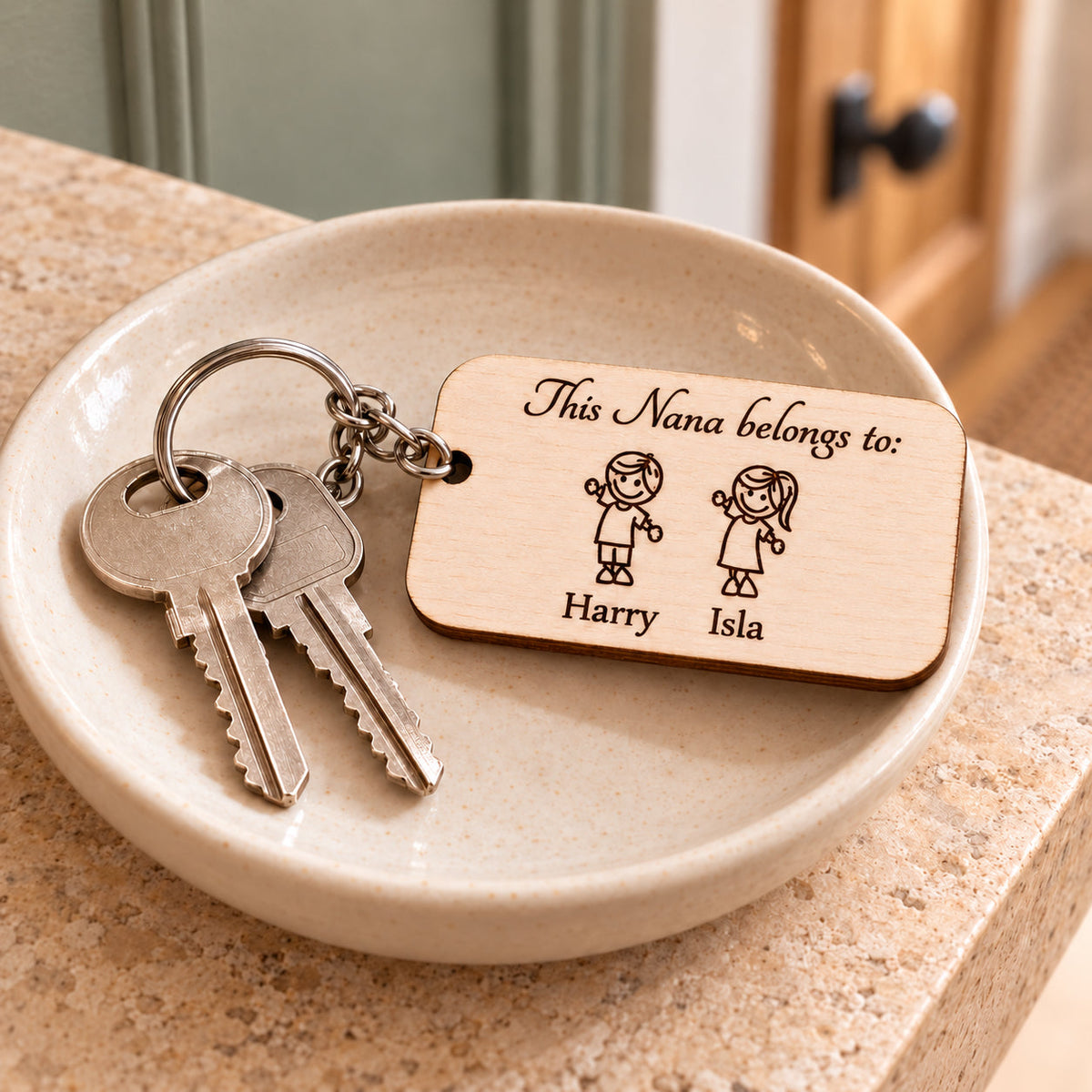
The little wooden tag in the opening photograph reads “This Nana belongs to:”, with Harry and Isla underneath. The heading and the children’s names have different jobs. One tells you whose keys they are. The others tell you who gave them to her.
On our grandma keyring, the first thing to enter is what you call her. For the pair above, you’d put Nana Jo on one order and Nana Sue on the other. On each, list the children with their chosen illustrated figures in the order you want to see them, from left to right. The heading sits above them, so Nana doesn’t count as a figure unless you want her pictured too.
If she’s still deciding between names, give her the card first. Once she’s signed a reply, you’ll have her spelling in her own hand. For a gift with room for a longer message, there are examples in our guide to gifts for Nan.
A first card, a photo and a gift tag
“Love, Nanna. Two n’s, just like my mum.”For a family spelling passed down.
“Your first Sunday lunch with Granny May.”For the back of a family photograph.
“For Nana Jo, from your two little helpers.”For the gift tag the children sign.
For a dated keepsake, add the month and year on a fresh line. Our engraving ideas include more wording for pieces with a dedicated message space.
Questions about choosing a grandma name
Is Granny or Grandma more common in Britain?
Grandma came first overall in YouGov’s survey. Of the British adults surveyed, 31% remembered calling at least one grandmother Grandma and 12% used Granny. In Scotland, 30% recalled using Granny and 19% Grandma. People could give more than one answer.
What if both grandmas want to be called Nana?
They can both be Nana. Add a first name when the distinction matters, as in ‘Nana June is collecting you today’ or ‘Shall we ring Nana Val?’ If a child calls out ‘Nana!’ and both turn round at Sunday lunch, that can be part of the fun.
Does Nan mean Mum’s mum or Dad’s mum?
In English, Nan can be a grandmother on either side. One family might have Nan on Dad’s side and Granny on Mum’s, while their cousins do it the other way round. If you’re writing to a child about a particular visit, use the name that child knows.
Can a child use grandma names from two languages?
Yes. A child might call one grandmother Nonna and the other Gran. They might also say ‘my grandma’ when telling a friend about Nonna, then greet her with ‘Ciao, Nonna!’ on the phone. For a card, ask her how she writes the name herself.
What can the children call a step-grandma?
Start with what she and the children are comfortable saying. An older child who has always called her Jo may want to keep doing that. A younger sibling might settle on Nana Jo. She can answer to both, and each child can use their own greeting in a birthday card.
What can we call a great-grandma who already goes by Gran?
Ask whether she wants to keep Gran. If she does, her grandchild and great-grandchild can both use it. On a family photo, a caption such as ‘Elsie with her great-grandma, Gran Jean’ explains the generations and still records the name Elsie calls her.
Should we choose a grandma name before the baby arrives?
You can try one without settling it straight away. Say it in an ordinary sentence, such as ‘Would you like Nana to read that one?’ If she’d like to wait and hear what the baby eventually calls her, put a date or a message in the first card and save the nickname for later.
Can the keyring say Nanna with two n’s in the middle?
Yes. Enter Nanna in the ‘What do you call her?’ field and the heading will read ‘This Nanna belongs to:’. If it’s a surprise, look at how she signed her last birthday card. Then list each grandchild’s name beside their chosen figure in the order you want them to appear.


Join the conversation +