Bedroom Door Signs for Kids: How to Choose One That Feels Like Them
Practical advice from Monika on choosing a name sign that fits your child and their room, with tips on size, colour, wording and mounting.

In this guide
Before you order a name sign, stand in the hallway and look at the bedroom door. There may already be a coat hook, a painted panel and a collection of drawings taped up at child height. The space for a new sign is easier to judge there than in a neatly styled photograph.
I’m Monika, the mum behind Creative Mama in Hull. We make personalised wooden signs in our family workshop, and a name, a colour and a few centimetres make a surprising difference to the finished design. For bedroom door signs for kids, I’d start with the place the sign will go and the child who will walk past it every day.
This guide brings together the things I’d check before choosing: a theme they enjoy, lettering that works with their name, a size that fits the space and a sensible way to mount it. Our personalised bedroom door signs include several shapes; you don’t need to decide on one before measuring.
Measure the door or wall before choosing a size.
Spelling, wording and letter height all matter.
Compare the colour with the room’s actual light.
Give them a choice you can both live with
A child can have very definite opinions about their room without being interested in paint samples or curtain lengths. A small sign is a manageable place to involve them. I’d offer two or three designs that already fit the space, then let them choose the motif or name colour.
That could mean football players, flowers, a teddy bear or dinosaurs. The theme doesn’t have to match every other thing in the bedroom. If they want a dinosaur on the door, you can keep the rest of the room as it is and give that interest one clear place.
For a dinosaur fan, compare the dinosaur name signs before deciding whether you want one plaque or a name with separate wall decorations. Those are different decorating jobs, even when the theme is the same.
“Which one would you like to see on your door?” is an easier decision than “How shall we decorate your whole bedroom?” Let them choose from the options you are happy to order.
A name on the door and a name on the wall do different jobs
A door plaque gives you one finished piece to position. It can mark their bedroom without taking over the room. Look at the door panels, handles and hooks first, then choose a shape that leaves some breathing space around those everyday things.
A wall display gives you more freedom with the layout. Joined wooden name lettering sits directly against the wall, while a set of separate shapes lets you decide how far apart the pieces should go. You need to measure the whole arrangement, including the gaps you want to leave.

A football name plaque keeps the raised name, player silhouettes and engraved wording together in one piece.

The daisy plaque shows a raised first name with an optional additional name engraved underneath.
The football bedroom door sign is a useful example of a single plaque. Our kids’ room signs and wall decorations also include joined names and themed sets if you are planning a larger feature.
Open the bedroom door fully before choosing a position. A wall hook, neighbouring cupboard or the wall behind the door may sit much closer than you expect. Raised lettering needs enough clearance to avoid being knocked each time the door opens.
Measure the space before falling for the photograph
I’d make a paper template before choosing a size. Cut a circle or rectangle to the product’s listed measurements and hold it against the door. Stand back into the hallway, then look again with the door open. You can see whether it feels cramped without ordering anything first.
For a wall set, lay the pieces out on paper or mark the overall area with a paper template. Include the spaces between the name and the decorations. A 30 cm name can sit inside a much wider arrangement once you add dinosaurs around it.
| Design | Size | What to measure |
|---|---|---|
| Round star plaque | 12, 17 or 20 cm | The diameter of the whole plaque, including its border. |
| Joined name letters | 20, 30 or 50 cm | The total name width. Letter height varies with the name and font. |
| Name with five dinosaurs | Name width + layout | The size selects the name width. Allow extra space for the dinosaurs and the gaps between the pieces. |
These examples come from our round star bedroom door plaque, wooden name letters and name and five-dinosaur wall set. Always use the measurements for the particular design you choose; “Large” is not one fixed size across the shop.
For joined lettering, a short name and a longer name can both be 30 cm wide, but the longer name needs smaller letters to fit that width. If letter height matters to you, send us the exact name and the space available so we can check that combination.
Read the name as they will see it
I’d choose the spelling first, then look at the letters themselves. A script font can have a lovely flow, but the shape of an individual letter may be different from the print your child sees in a reading book. Ask them to look at the whole name if they are old enough to join in.
When I’m checking a personalised layout, the useful question is how that particular name fits. Initials, hyphens and a long second name all affect the space. Our joined name lettering offers four script styles; the font choices on a shaped plaque can be different or fixed to the design shown.
For a double name, keep the hyphen and capital letters exactly as you want them. A layout with a raised first name and an engraved additional name can be helpful when you want both included. The daisy name plaque shows that arrangement with Amelia and Lily-Mae.
The wording boxes work differently on different signs. On the star plaque, enter the full wording, such as “Sonny’s Room”. On the football plaque, enter the first name only and choose the lower engraved wording separately. Read the instructions beside the fields before typing.
A name alone works well when you want to keep the wording simple. “Room”, “Bedroom” or a short phrase may suit a particular design, but check what that product allows. If you would like a different arrangement, ask us before ordering rather than squeezing a long instruction into the name box.
Choose the colour in the room where it will live
A colour that looks clear on a white background can disappear against a door in a similar shade. I’d compare the available finishes with the actual paint, bedding and light in the room. Think about how easy the name will be to see from the hallway as well as how it looks up close.
You can pick up one existing colour without matching everything. Navy lettering might echo a duvet cover; a warm yellow detail might work with a favourite print. If the child has chosen a brighter colour than you expected, a small door plaque can give it a place without changing the whole room.

Joined name lettering lets the wall colour show around and through the letters. Check the whole name width before ordering.

A name with five separate dinosaurs gives you a layout to plan. The pieces can be spaced to suit the available area.
Also check which parts change colour. On our star plaque, the name and stars have separate colour choices, while the natural wood base and white border stay as shown. On the football plaque, the name colour changes and the player silhouettes remain black.
The colour chart is a guide: screens and room lighting can change how a finish looks. Birch also has its own grain and wood tone. If you are trying to match an exact paint shade, speak to us before ordering so we can discuss what is possible.
Make room for both names in a shared bedroom
For siblings, I’d agree on the positions before choosing the designs. Two signs on one door need to look balanced together, and two wall names need enough space around each child’s area. A matching size or shape can keep the arrangement tidy while leaving the theme or colour to each child.
If one name is short and the other is long, the same overall width will not give you the same letter height. Decide which matters more for your room: an equal space for each sign or lettering that looks similar in height. Ask for help with the dimensions if the names need to sit together.
Separate plaques are straightforward when each child wants a different motif. For one sign with both names, or wording for a shared playroom, contact us with the exact text and measurements. We can check a custom arrangement before you commit to an order.
For a nursery or a gift, start with the name you know
When you are preparing a nursery, it is easy to order the finishing touches before deciding where the furniture will go. I’d place the larger things first, then choose a wall or door space for the name. Keep decorations securely out of reach and away from directly above a cot or bed.
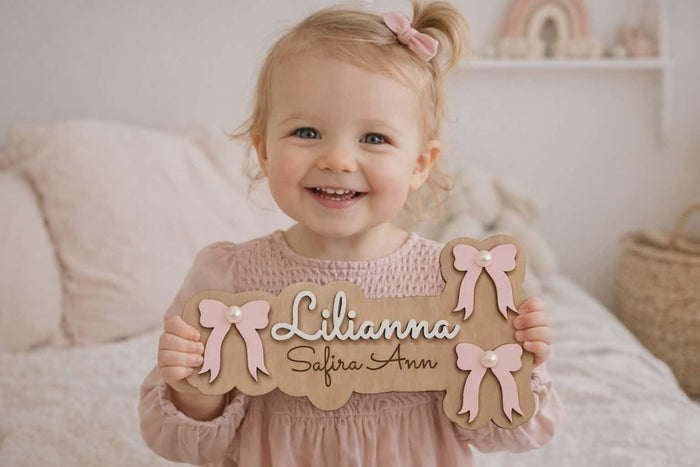
Our nursery name signs include gentler themes and simple lettering as well as shaped plaques. Think about the room you will use day to day: the door, a reading corner or another clear wall area may be a better position than the first spot in a styled photograph.
If you are buying for somebody else, check the name quietly before ordering. A nickname you use may be different from the name the parents want on the wall. Ask for the spelling, any hyphen and the room colours; those details matter more than trying to make the largest possible surprise.
If the baby’s name has not been shared, I’d wait before ordering a name sign. A nursery decoration is also a different choice from a plaque for a first newborn photograph. Our baby announcement guide explains the wording and photo options for that moment.
Think about the surface before you attach anything
A clean, dry, smooth indoor surface is the starting point for the adhesive pads included with the signs shown here. Read the fitting information for your chosen product and check the finish on your door or wall. Wallpaper, textured paint and delicate surfaces need particular care.
Fresh paint can feel dry before it is fully cured. Follow the paint manufacturer’s curing advice and the instructions for your fixing method. If you choose a replacement adhesive, use its own application and removal directions; 3M’s Command guidance is one example of why surface type and curing time matter. Its instructions apply to Command products, rather than every adhesive pad.
I’d plan the position with the paper template, then have an adult fit the sign. Mount it securely out of children’s reach, avoid positions directly above sleeping areas and keep separate small decorations where they cannot be pulled down. These wooden signs are room decorations, not toys.
In a nursery, keep decorative pieces outside the cot and its sleep space. The Lullaby Trust’s clear-cot guidance is a useful reminder when arranging the room.
For everyday care, use a soft, dry cloth and keep the wood away from moisture. Handle fine lettering gently if you are moving it. Adhesive pads should not be assumed to come away without affecting paint or wallpaper; if easy removal is essential, check the surface and fixing options before ordering.
The little checklist I’d use before ordering
We usually dispatch by the next working day after payment and complete personalisation details are received. If a design needs approval, preparation starts once it is approved. Delivery is additional, so for a birthday or a room reveal, check the current delivery options before choosing the date.
Questions I’d ask before choosing a bedroom name sign
Choose a question to read the answer
Size, names & wording
1. What size should a child’s bedroom door sign be?
Measure the clear area on the door and compare it with the whole sign dimensions. A paper template helps you judge the space around handles, hooks and panels. Our round star plaque comes in 12, 17 and 20 cm diameters, but other designs use different measurements. Choose from the individual product’s size guide.
2. Can a bedroom door sign also go on a wall?
Many of our plaques can be displayed on a suitable indoor wall as well as a door. Check the product’s mounting information and dimensions first. Joined name lettering or a set with separate decorations gives you more layout options if you want a larger wall feature.
3. Will a long name have the same height as a short name?
Not necessarily. With lettering sold by total width, more letters need to fit into the same space, so the letter height can be smaller. Backed plaques are also arranged around the wording. Send us the exact name, font where applicable and available space if you need to confirm the proportions before ordering.
4. Can you make a double-barrelled name or include a middle name?
Check the character limit and personalisation fields on the chosen design. Some allow a double name in the main lettering; others have a separate field for an engraved additional name. Include the hyphen and capitals you want. Contact us first for a longer name or an arrangement the product page does not show.
5. Should I enter the name only or the full wording?
Follow that sign’s instructions. The round star plaque asks for wording such as “Sonny’s Room”. The football plaque asks for the first name only, with the lower engraved wording entered separately. Reading the field labels avoids repeating “Room” or adding the possessive ending twice.
6. Can a personalised sign say something other than Room or Bedroom?
Some designs have an editable wording field, while others are name-only signs. Check the options shown on the page. For a shared room, reading corner or another short phrase, send us the text and available space before ordering so we can check whether that design will suit it.
7. Can I choose the font?
Our joined wooden name letters offer four script styles, with examples in the font guide. Shaped plaques may use a fixed decorative font, so the choices are not the same across every sign. If you want to see how a particular name looks in an available font, ask us for a preview.
Colours & shared rooms
8. Can the name and decorations be different colours?
Where the product offers separate colour fields, yes. The star plaque lets you choose the name colour and star colour independently. Other designs have details that stay as pictured, such as the football plaque’s black player silhouettes. Use the individual colour fields rather than assuming one selection changes every part.
9. Are wooden name signs suitable for boys and girls?
Choose around the child’s interests and the colours they enjoy. Football, flowers, dinosaurs and stars do not need to be restricted to one child or another. Compare the actual design and personalisation choices rather than deciding only from a product’s title.
10. What would work for children sharing a room?
Two individual plaques allow each child a different motif or colour while keeping a common size or shape. For wall lettering, remember that equal name widths can produce different letter heights. If you want both names on one piece, ask us about the wording and layout before ordering.
Mounting & care
11. Do I need to drill holes to fit these signs?
The designs pictured in this guide include adhesive pads for suitable indoor surfaces, so drilling is not part of their usual fitting method. Surface suitability still matters. Read the instructions for your chosen sign and contact us if you are unsure about a textured, papered or delicate surface.
12. Can I put a sign on a freshly painted door or wall?
Wait until the paint has fully cured, following the paint manufacturer’s advice and the fixing instructions. Touch-dry paint is not always ready for adhesive. There is no single waiting period that applies to every paint and every pad, so check both before fitting the sign.
13. Will the sticky pads remove without damaging the surface?
We cannot guarantee damage-free removal. The result depends on the adhesive and the paint, wallpaper or other finish underneath. Check suitability before applying anything and follow the fixing’s removal instructions. If you are renting or protecting a delicate finish, decide on the mounting method before ordering.
14. Can I use a nursery name sign outside or as a toy?
The wooden signs shown here are indoor decorations. Keep them dry, mount them securely out of children’s reach and keep loose pieces away from the cot or play area. They are not designed for outdoor weather, handling as toys or use inside a baby’s sleep space.
Gifts & delivery
15. Is a name sign a good new baby or birthday gift?
It can be a personal gift when you know the exact name and the room style. Ask about spelling and colour preferences first, especially for a baby whose name has only recently been announced. For an older child, a favourite theme can help you choose. If the name is still undecided, wait before ordering personalised name lettering.
16. How long does a personalised bedroom sign take?
We usually dispatch by the next working day once payment and complete personalisation details are received. If a preview needs approval, preparation starts after approval. Allow separate time for delivery; dispatch does not mean arrival the next day. For a fixed occasion, contact us before ordering to check the options.
Find a design they can help choose
Start with the bedroom door plaques for a single piece, or browse nursery name signs for wooden lettering and gentler themes. Keep your measurements nearby and compare the details on the product you like.
Explore kids’ room signsBy Monika Krzeminska, Creative Mama. Product sizes, wording fields and finish options checked on 9 October 2026. Always check your chosen product page for its current options, and use the fitting instructions for the adhesive you choose.



Join the conversation +